01
100% local inference
Every AI query runs on the appliance. We ship you a monthly network-egress audit log proving 0 bytes left your box. Your client data is protected by physics, not by a privacy policy.
A small hardware appliance sits in your office. We import your years of Excel + email + PDF case knowledge. Your private AI is ready in 7 days — and your client data physically never leaves the box. ABA Model Rule 1.6 compatible by design.
ABA Model Rule 1.6 compatible · 0 bytes leave your office · Anti-hallucination citation grounding
Currently in pre-launch. First wave ships to early-access waitlist customers when general availability opens.
Three things keep happening this week:
You spent another 5 hours answering questions you've answered 50 times before — clients asking what the next step is, what a clause means, whether they need a will if they have a trust. Time you can't bill.
You looked at Clio Duo. Spellbook. Harvey AI. All three process your client content on their cloud. The fine print says "reasonable efforts" — your bar association says that's not enough.
You opened ChatGPT to draft something quickly and stopped before pasting the client name. Again. The bar warning was clear. The Krafton CEO subpoena — where "deleted" ChatGPT chats became central evidence in a $250M lawsuit — was clearer.
Meanwhile, the years of case files, FAQ answers, and client templates that are your professional knowledge sit in scattered Excel files, email threads, and Notion docs — and no AI can use them.
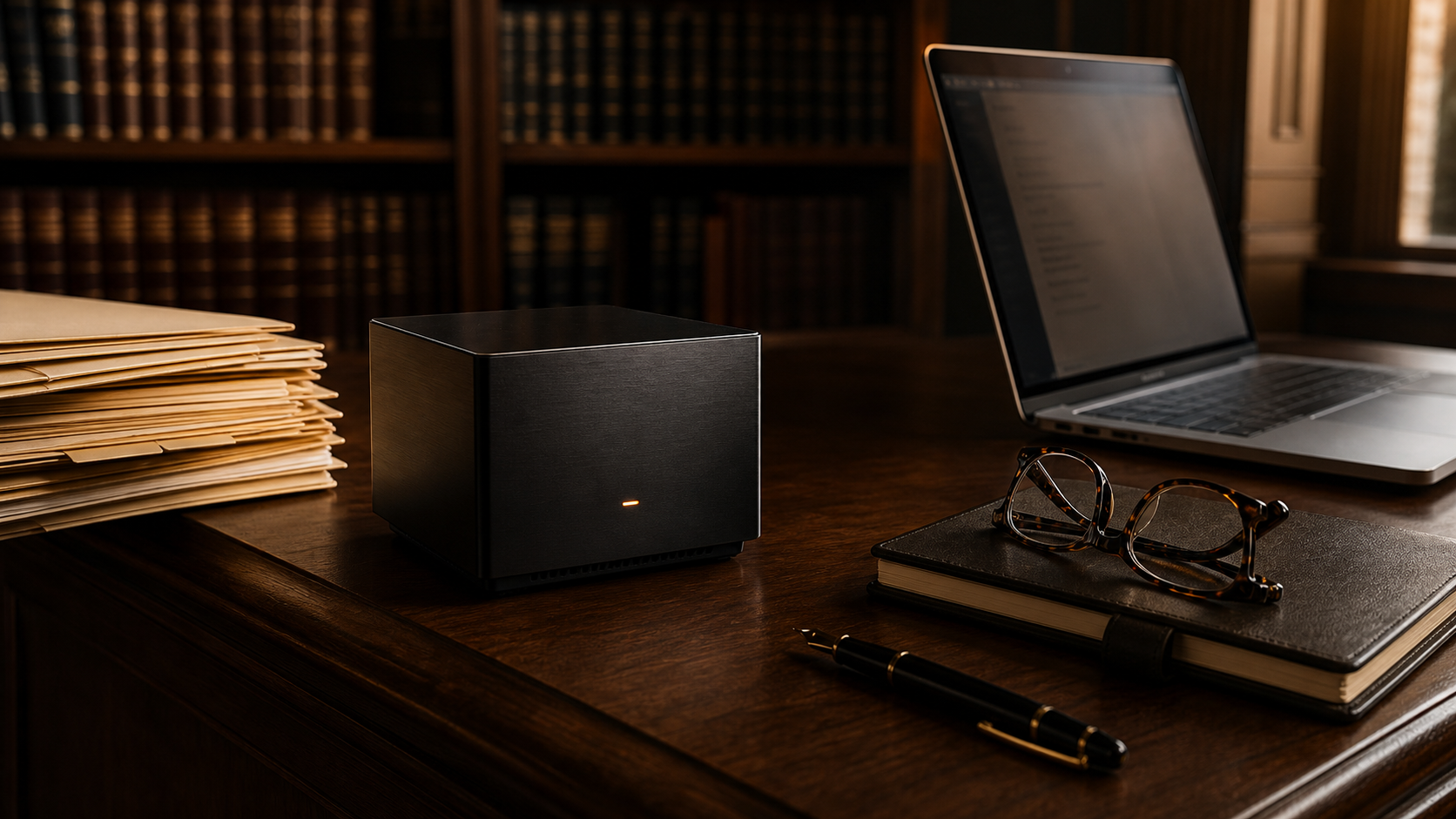
Consultant Private Brain is a small AI appliance that sits in your office. We do a one-time white-glove import of your historical case knowledge — Excel, Notion, email, PDF, even paper scans. In 7 days, your private AI runs on your own files. Every query stays on the box. Every answer cites a source document from your own knowledge base. Nothing — not a name, not a clause, not a question — ever touches a cloud LLM provider.
It is not a replacement for Clio. It is not a chatbot widget for your website. It is the AI knowledge layer your practice couldn't safely build before.
Each is a deliberate engineering choice, not a marketing claim. The audit log, the citation grounding, and the sovereignty contract exist because the bar warnings do.
01
Every AI query runs on the appliance. We ship you a monthly network-egress audit log proving 0 bytes left your box. Your client data is protected by physics, not by a privacy policy.
02
We triage your messy historical data — Excel, Notion, email, PDF, paper scans — and have your AI running on it in 7-14 days. Productivity from day 7, not month 6.
03
Every answer must cite a source document from your private knowledge base. The AI refuses to answer when grounding evidence is absent. Avoid the sanctioned-lawyer-with-fake-citations scenario.
04
Your data + your model + your hardware survive our company. If we fail, the firmware update channel goes to open-source escrow. The box keeps working forever.
05
Turn on a private self-serve Q&A portal for your clients. Each gets a login. Complex questions route to you. Reclaim up to 10+ hours a week of repetitive Q&A (target persona estimate) — without violating privilege.
PRICE
12× cheaper than the mid-firm $35K DIY case study. 100× cheaper than Harvey AI's $288K/yr floor. Pays for itself in one extra billable hour a month.
01
Free triage call: you walk us through how your case knowledge is organized today. We quote your first-import scope and tell you what we can ingest and what needs to wait.
02
We ship the appliance pre-configured. Our import team works through your historical data over an encrypted, lawyer-controlled drop. Your private AI is trained on your own cases before the box ever leaves your shelf.
03
Unbox. Plug in. Open the lawyer-facing chat UI. Ask "how did I handle the [X] issue in the Smith matter last year?" Your AI answers with the exact case citation from your own files.
We are pre-launch and refuse to invent testimonials. These cards are placeholders for the seed customers we're onboarding through the waitlist now. We'll replace them with real names, real photos, and real outcomes — once they've used the product long enough to have something honest to say.
"Customer testimonial — replace before GA. Target case: a solo estate-planning attorney recovering 7-8 hours a week of FAQ time within 30 days of portal launch."
"Customer testimonial — replace before GA. Target case: a 3-attorney immigration boutique citing the white-glove first-import as the unlock that prior DIY attempts couldn't deliver."
"Customer testimonial — replace before GA. Target case: an independent educational consultant using the client-facing portal for parent intake without touching FERPA-protected data."
PrivateGPT and Ollama are open-source engines — we use parts of that ecosystem. What we sell isn't the engine; it's the bundled appliance, the white-glove import of your messy historical case data (Excel + email + PDF + paper scans), the legal-vertical anti-hallucination layer that DIY stacks don't have, and the support contract for when something breaks before a filing deadline. About 5% of solo lawyers can DIY successfully — for the other 95%, the all-day-Sunday setup never finishes.
The box keeps working. Your data is stored in open formats on hardware you own. The firmware is signed, but the model + RAG layer can be swapped with any compatible engine (Llama, Qwen, Mistral, Phi). If we fail, the firmware update channel is contractually committed to open-source escrow. We can't lock you in even if we wanted to — that's the point of the sovereignty contract.
No private vendor can certify compliance — that's the lawyer's professional duty. What we provide is the engineering substrate the rule's "reasonable efforts" standard expects: zero outbound API calls (with audited proof), no third-party data processors, and a contractual commitment that we have no read access to your data. We publish a compatibility statement reviewed by external legal-AI ethics counsel; that statement plus the audit logs are the artifacts your bar association expects when evaluating your tooling choices.
It is engineered to refuse. Every factual answer must be grounded in a source document from your private knowledge base — if the answer would require external case law we don't have access to, the AI returns "I cannot answer this from your files; check Lexis / Westlaw". We do not pretend to replace external legal research. We replace the friction of getting at your knowledge.
No — and we don't recommend you try in year 1. We're the AI knowledge layer next to your case-management system, not on top of it. Clio still does billing, intake forms, calendar, conflict checking, trust accounting. We handle the AI work Clio can't safely do (your private knowledge base) and the work Clio doesn't do at all (anti-hallucination drafting, optional client-facing private Q&A). Year 2 we'll publish integrations for the major PM systems.
One billable hour a month covers the subscription. The McKinsey legal-automation benchmark is 23% of a lawyer's job is automatable — most of that is what we capture (FAQ, intake, knowledge recall, drafting from prior work). Concretely: if you bill $300/hr and our private AI helps you recover 4 hours a week of administrative + repetitive Q&A time, you net ~$50K/yr in recovered billable capacity against an expected ~$2,500 total cost — a 20× illustrative return on year 1 (your actual ROI depends on your hourly rate and recoverable hours).
We open early access in waves. The first 100 customers get a 50% lifetime subscription discount, plus lifetime access to all future vertical templates (immigration, college admissions, tax, retirement planning). We'll review your data privately on a 30-minute discovery call before any commitment — and once GA opens, every order is backed by a 30-day satisfaction guarantee on hardware.
No credit card · No commitment · We'll quote your first-import scope on the 30-min call